|
|
|
Beyond Amyloid: Why multi mechanism approaches
are needed in Alzheimer's therapy |
|
|
|
|
|
|
|
|
|
The FDA approval of anti amyloid monoclonal antibodies represents a milestone in Alzheimer's therapy, yet their real world impact remains limited. These agents remove plaques and modestly slow decline, but ARIA related dropout and persistent intracellular deterioration reveal a critical truth: amyloid clearance alone cannot restore the signaling architecture required for cognitive function.
At the center of this architecture is GSK-3, the mechanistic link between extracellular amyloid stress and intracellular Tau hyperphosphorylation. Left unmodulated, GSK-3 activity drives synaptic deterioration and ongoing neurodegeneration, processes untouched by amyloid-targeting therapies.
A1070722 fills this gap as an ultra-potent, brain-penetrant GSK-3 inhibitor validated as a PET radiotracer in primates, showing distribution patterns that mirror human GSK-3 and support future translation. Its combined therapeutic and PET-imaging properties create a direct bridge from preclinical rescue to clinical-scale target engagement.
|
|
|
|
|
|
|
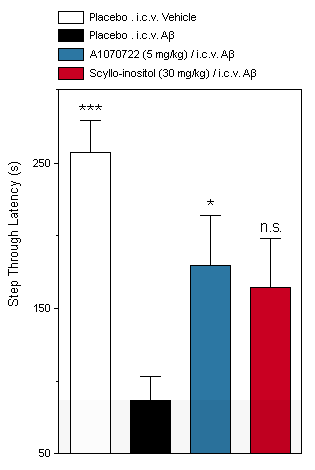
In Neurofit's Aβ-induced memory-impairment model, chronic A1070722 treatment produced clear, statistically significant cognitive improvement whereas Aβ-aggregation-focused inhibitors such as scyllo-inositol showed non-significant trend toward recovery. This comparison underscores an important therapeutic insight: amyloid-directed approaches alone offer incomplete rescue, and fuller functional benefit likely requires interventions that act through complementary mechanisms particularly those modulating the downstream GSK-3/Tau signaling axis. As Alzheimer's pathology reflects multiple converging biological failures, therapeutic strategies that combine amyloid removal with intracellular pathway correction represent a more rational and potentially more effective path toward disease modification.
|
|
|
|
|
|
|
|
Our early screening protocol positions A1070722 as a high-confidence comparator, allowing rapid identification of compounds unlikely to withstand Phase II demands.
Combination strategies, pairing amyloid removal with targeted intracellular pathway correction, represent a more comprehensive future direction for Alzheimer's therapy. Compounds such as A1070722 illustrate how downstream GSK-3/Tau modulation can complement amyloid-directed approaches, highlighting the value of multi-mechanism interventions in a landscape where amyloid removal alone is no longer sufficient.
|
|
|
|
|
|
|
|
|
|
|
|
Effect of A1070722 and Scyllo-Inositol on i.c.v. Aβ-induced cognitive deficit-induced in the rat
The graph shows the cognitive performance of rats in the passive avoidance test. Control rats (white column) still remember the previous aversive experience (electric shock) and avoid entering the dark chamber. i.c.v. Aβ-rats (black column) forget the association between the context and the foot shock (hence shorter step through latency; white vs black column).
Treatment of i.c.v. Aβ-rats with A1070722 enhances the recall of the context shock paired-chamber (hence, significantly (p value = 0.0243) extended step through latency; black vs blue column).
In contrast, treatment of i.c.v. Aβ-rats with Scyllo-Inositol enhances the recall but the effect was not statistically significant (p value = 0.0563).
|
|
|
|
|
|
|
|
|
|
|
|
|
|
|
|
Please, do not hesitate to consult our website for more information about our animal and neurocellular models, or to contact us directly for bespoken solutions.
Kind regards, NEUROFIT team
|
|
|
|
|
|
|
|
|
|
|
|
Tel : +33 (0)3 88 65 16 06

|
|
|
|
|
|
|