
 PREVIOUS
Newsletter # 129

In vivo studies
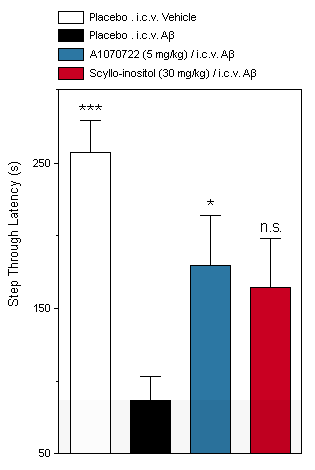
In Neurofit’s Aβ‑induced memory‑impairment model, chronic A1070722 treatment produced clear, statistically significant cognitive improvement, whereas Aβ‑aggregation–focused agents such as scyllo‑inositol showed non‑significant trend toward recovery. This comparison underscores an important therapeutic insight: amyloid‑directed approaches alone offer incomplete rescue, and fuller functional benefit likely requires interventions that act through complementary mechanisms — particularly those modulating the downstream GSK‑3/Tau signaling axis. As Alzheimer’s pathology reflects multiple converging biological failures, therapeutic strategies that combine amyloid removal with intracellular pathway correction represent a more rational and potentially more effective path toward disease modification.
Our early screening protocol positions A1070722 as a high‑confidence comparator, allowing rapid identification of compounds unlikely to withstand Phase II demands.
-
-
The graph shows the cognitive performance of rats in the passive avoidance test. Control rats (white column) still remember the previous aversive experience (electric shock) and avoid entering the dark chamber. i.c.v. Aβ-rats (black column) forget the association between the context and the foot shock (hence shorter step through latency; white vs black column). Treatment of i.c.v. Aβ-rats with A1070722 enhances the recall of the context shock paired-chamber (hence, significantly (p value = 0.0243) extended step through latency; black vs blue column). In contrast, treatment of i.c.v. Aβ-rats with Scyllo-Inositol enhances the recall but the effect was not statistically significant (p value = 0.0563).