Targeting the Integrated Stress Response: Guanabenz for Alzheimer’s cognitive deficits


Newsletter # 134


In vivo studies


Clinical Rationale
Guanabenz (GBZ) is a well-established, FDA-approved central alpha-2 adrenergic receptor agonist originally utilized for the management of hypertension. However, modern neuropharmacology has shifted focus toward its profound, off-target ability to modulate the Integrated Stress Response (ISR) by selectively inhibiting the GADD34-PP1 phosphatase complex. By prolonging eIF2α phosphorylation, GBZ protects cells from endoplasmic reticulum (ER) stress and attenuates chronic neuroinflammation—mechanisms directly implicated in the progression of Alzheimer’s disease (AD) and other neurodegenerative conditions.

Currently, its clinical repositioning for neurodegeneration spans multiple indications; it has been actively investigated in Phase 1/2 clinical trials for neuroinflammatory and white matter pathologies (such as Vanishing White Matter disease and Multiple Sclerosis) to evaluate its safety, pharmacokinetics, and capacity to halt myelination deficits and cognitive decline. The major clinical challenge is achieving therapeutic CNS exposure without triggering the peripheral hypotensive and sedative side effects associated with classic alpha-2 agonism. Consequently, demonstrating a clear preclinical therapeutic index where GBZ selectively rescues cognitive pathways from inflammatory stress is vital for its advancement in AD pipelines.
Preclinical Evidence: Rescuing Spatial Working Memory and executive navigation function

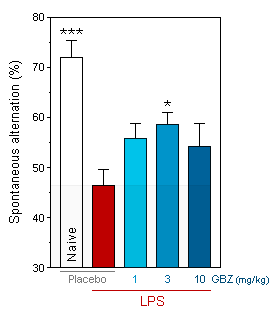
Data generated by Neurofit demonstrates that treatment with GBZ selectively restores Lipopolysaccharide (LPS) inflammation -associated cognitive deficit in mice. Specifically, at a targeted dose of 3 mg/kg, GBZ significantly rescues spontaneous alternation, driving executive navigation performance back toward baseline levels.

  • * indicates p ≤ 0.05, as compared to red column
    *** indicates p ≤ 0.005, as compared to red column
  • The mouse spontaneous alternation assay serves as a high-fidelity proxy for evaluating this specific type of spatial working memory and executive navigation. The challenge with LPS drops spontaneous alternation performance dramatically from over 70% down to under 50%. Mechanistically, this therapeutic response aligns with GBZ’s role in modulating neuroinflammatory pathways and stabilizing cellular stress responses, offering a highly predictive signal for preserving working memory pathways in AD patients.



If you are interested in these models and would like to learn more about them or other models and assays available at NEUROFIT, please visit our website : THERAPEUTIC AREA or TESTS sections


NEUROFIT offers a range of validated in vitro and in vivo screening tests for psychiatry and neurology.

If you need further information, please do not hesitate to contact us, we will reply within few days. Custom protocol

On a regular basis we distribute newsletters with scientific information on our research services. If you wish to receive these, please :