 PREVIOUS
Deconvoluting Serotonergic Portfolios
Newsletter # 135

Animal models
-
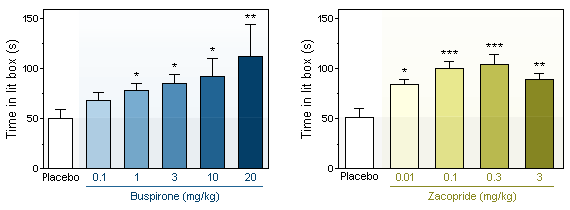
By tracking these pathways side-by-side, our platform provides developers with the specific resolution needed to map completely unique candidate trajectories:
• Linear Target Escalation (5-HT1A Pathway Baseline): Using Buspirone as a functional benchmark, the assay demonstrates a highly controlled, progressive dose-response curve spanning from 0.1 mg/kg up to 20 mg/kg (p < 0.01). This broad, stable tracking window is ideal for developers looking to verify in vivo target engagement, confirm systemic exposure, and map the functional thresholds of novel partial agonists or terminal autoreceptor modulators.
• Biphasic Potency Mapping (5-HT3/5-HT4 Pathway Baseline): Conversely, our Zacopride benchmark exposes an entirely different pharmacological signature—capturing significant pathway activation at an ultra-low threshold of 0.01 mg/kg (p < 0.05), peaking rapidly at 0.1 to 0.3 mg/kg (p < 0.001), and defining the exact window where receptor desensitization or downstream feedback loops take over (3 mg/kg, p < 0.01).
De-Risk Your Lead Optimization Early You do not need to invest in logistically burdensome, multi-week chronic animal dosing paradigms just to run an initial portfolio screen.
By leveraging our finely calibrated baseline environments, your discovery team gains a high-throughput, single-dose verification suite. Our tight statistical margins allow you to seamlessly cross-reference structural modifications with in vivo behavioral changes—giving you the precise resolution required to rank-order back-ups, identify minimum effective functional doses, and advance your premier CNS assets with total data confidence.
Specialized Assays for Psychedelic-Related Compounds (5HT2) We also leverage validated mouse paradigms to evaluate the neuroactive and cognitive profiles of novel psychedelic-inspired compounds:
• Marble Burying Test: Assesses attenuation of repetitive/stereotypic behaviors as a marker of neuroactivity.
• Scopolamine-Induced Alternation Deficit: Evaluates spatial working memory rescue to demonstrate cognitive enhancement and neuroplastic potential.
Explore our dedicated posters for deeper scientific insights:
Converging behavioral effects of diverse psychedelics via shared serotonergic pathways:
5-MeO-DMT exhibits neuroplastic and therapeutic potential Society for Neuroscience 2025
Psychedelic-induced neuroplasticity:
doi and psilocybin show promise in alleviating cognitive deficits and stereotypic behaviorsSadpd 2025
Get in touch